Debt-to-income ratio shows up twice in a custom home build — once at construction loan approval, and again when the permanent mortgage converts. Most people building a home focus only on the first. The second one is the number that determines whether the finished home actually fits your life.
43–45%
typical DTI ceiling for construction loan approval
2 DTIs
during construction and after — both affect you
~$3,500/mo
interest on a $600k loan at 7% when fully drawn
What DTI is
DTI — debt-to-income ratio — is the percentage of your gross monthly income that goes toward debt payments. Lenders use it to assess whether you can afford to take on a new loan obligation.
The calculation is straightforward: add up all monthly debt obligations (minimum credit card payments, auto loans, student loans, existing mortgage or rent) and divide by gross monthly income. $2,000 in monthly debt on $10,000 in monthly gross income produces a DTI of 20%. Most conventional mortgage programs allow a DTI up to 43–45% for approval, though better rates and terms generally favor something lower.
How construction lenders use DTI
Construction lenders calculate DTI the same way, but there's an important complexity: during the build, you're typically carrying two sets of housing costs simultaneously. If you haven't sold your current home, both your existing mortgage and the construction loan interest count in your DTI.
Your during-construction debt load might include:
- Your current mortgage or rent payment
- Interest-only payments on the construction loan (which grow with each draw)
- Car loans, student loans, and other recurring debt obligations
Construction loan interest grows as draws are released. By the time most of the loan is drawn, that monthly interest payment alone can add $1,500–$4,000 to your obligations depending on the loan amount and rate (the construction loan interest calculator will estimate yours). This is why the during-construction DTI is often the most constrained period — and why some lenders require you to sell your current home before or early in the build.
The two DTIs that matter
There are two distinct DTI moments in a build, and both matter — but they're often treated as if they're the same thing.
During-construction DTI is what you're carrying month to month while the build is active. Lenders check this at loan approval. It determines whether you can service the construction loan interest alongside your existing obligations without exceeding their limits.
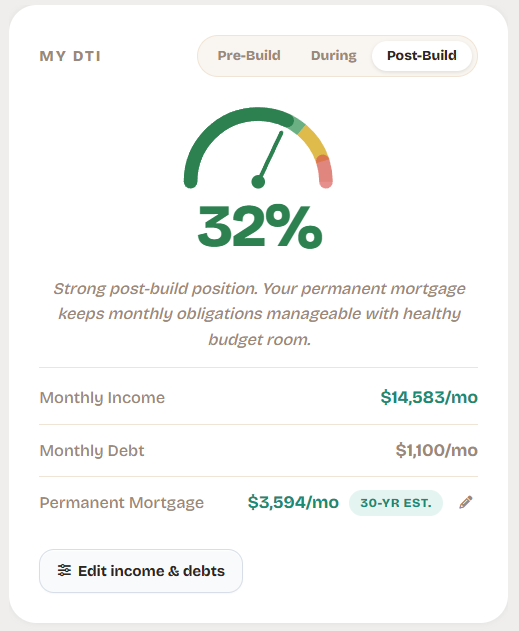
Finished-home DTI is what your ratio looks like after the construction loan converts to a permanent mortgage, your current home is sold (if applicable), and all construction-phase debt is resolved. This is the number that determines whether the finished home is actually affordable to live in long-term.
Most people building a home focus on getting construction loan approval without enough attention on the finished-home DTI. A build can be fully funded and completed while producing a permanent payment that's meaningfully harder to carry than expected — especially if rates have moved upward during the construction period.
What moves your DTI during a build
DTI isn't fixed — it changes as the build progresses and your financial situation evolves:
- Each construction draw increases your interest payment and raises your during-construction DTI
- Selling your current home drops a mortgage out of the calculation — potentially improving DTI significantly
- Paying off other debt (a car loan, a credit card balance) directly reduces your obligation total
- A rate increase between construction loan approval and permanent loan conversion raises the finished-home payment and finished-home DTI
- Income changes — a raise, a job change, a second income earner — shift the denominator
The timing of these events matters. If you sell your current home at draw 3 but construction runs to draw 9, there's a stretch where the construction loan interest is your only housing cost — which can actually improve DTI mid-build before it resolves again at close.
What to do if your DTI is too high
If your finished-home DTI comes back uncomfortably high, the options look different depending on when you discover it.
Before construction starts, you still have room to:
- Reduce the loan amount through scope reductions or a smaller build
- Increase the down payment — more cash in reduces the permanent loan and the monthly payment
- Pay down other debt to lower the obligation total
- Adjust the timeline if a salary increase or income event is near
The value of knowing the finished-home DTI early is that you still have meaningful choices. The finished-home DTI at the end of the build is a fact you have to live with. The finished-home DTI during the planning stage is a variable you can still change — but only if you're tracking it.
Keep reading
Can I Afford to Build This House?
Model the finished-home payment and DTI so you can see whether the build still fits your monthly life.
Open calculatorShould You Sell Your Current Home Before Building?
Compare the cash, DTI, reserve, and timing tradeoffs between selling first and carrying both for a while.
Read guideConstruction Loan Interest vs Mortgage Payment
Understand the difference between the temporary build-phase payment and the long-term mortgage payment after completion.
Read guide