Contingency isn't optional money set aside for things you might want. It's a specific reserve for cost increases you didn't predict — and the builds that run out of it before finishing are rarely the ones that had the worst surprises.
10–15%
of base construction cost — the standard reserve
Half used
early warning if most of the build is still ahead
0%
means every new cost comes straight from reserves
What contingency is (and what it isn't)
Contingency is a reserved portion of your budget set aside for cost increases within the original scope of the build. It's not a slush fund. It's not money for extras you decide to add later. It's specifically for things that were planned but came in over budget, or conditions discovered during construction that weren't visible before work started.
A foundation that hits unexpected rock. A material that prices higher than the estimate. A code requirement the inspector adds that wasn't in the original plan. These are contingency events. Change orders for scope additions — a bigger deck, upgraded countertops — should come from a different pool. When contingency gets used for wants rather than cost variances, the buffer that protects the whole build disappears.
Why 10–15% became the standard
The 10–15% range reflects the reality of how custom homes get built. Even well-managed builds with experienced contractors and clear plans encounter cost surprises. Material prices move. Site conditions vary from initial assessment. Code interpretations differ between inspectors. Labor availability shifts during long builds.
Experienced builders and construction lenders have seen enough projects to know that builds with less than 10% contingency run out of buffer before they run out of surprises. 10% is the floor. 15% provides meaningful room to absorb multiple surprises without the build becoming financially precarious. To see what each level means in dollars for your house, try the home build cost calculator.
Higher contingency is appropriate when:
- The site has significant unknowns — steep, rural, or ground conditions that weren't fully investigated before purchase
- The design is complex, highly customized, or involves specialty materials or trades
- The build timeline is long (18+ months)
- You're building in an area with volatile material costs or labor shortages
- It's your first custom home build
What contingency actually covers
Common contingency events on a custom home build:
- Foundation conditions that require additional engineering, deeper footings, or more material than estimated
- Utility connections that cost more than the initial estimate, especially on rural sites with long runs
- Material price increases between the time bids were collected and when purchases are actually made
- Subcontractor overages that your general contractor passes through on cost-plus or allowance items
- Code changes or inspection requirements added after construction begins
- Weather-related delays that extend the construction loan term and add interest costs
- Errors discovered during construction that need correction before the next phase can proceed
What contingency does not cover: design upgrades, scope additions, or decisions that weren't in the original plan. Using contingency for these makes the budget look intact when the real buffer has been spent on choices.
What happens when contingency runs out
When contingency is gone, every additional cost — regardless of how reasonable or unavoidable — has to come from somewhere else:
- More cash from your personal reserves
- An increased construction loan (requires lender approval, an additional inspection, and sometimes a new appraisal)
- Cutting scope elsewhere in the remaining build
None of these are comfortable mid-build. The builds that run out of contingency are usually not the ones that had the worst surprises. They're the ones that didn't track the contingency balance as it eroded — using it for scope additions along the way, or failing to book it against change orders as they were approved.
How to protect your contingency budget
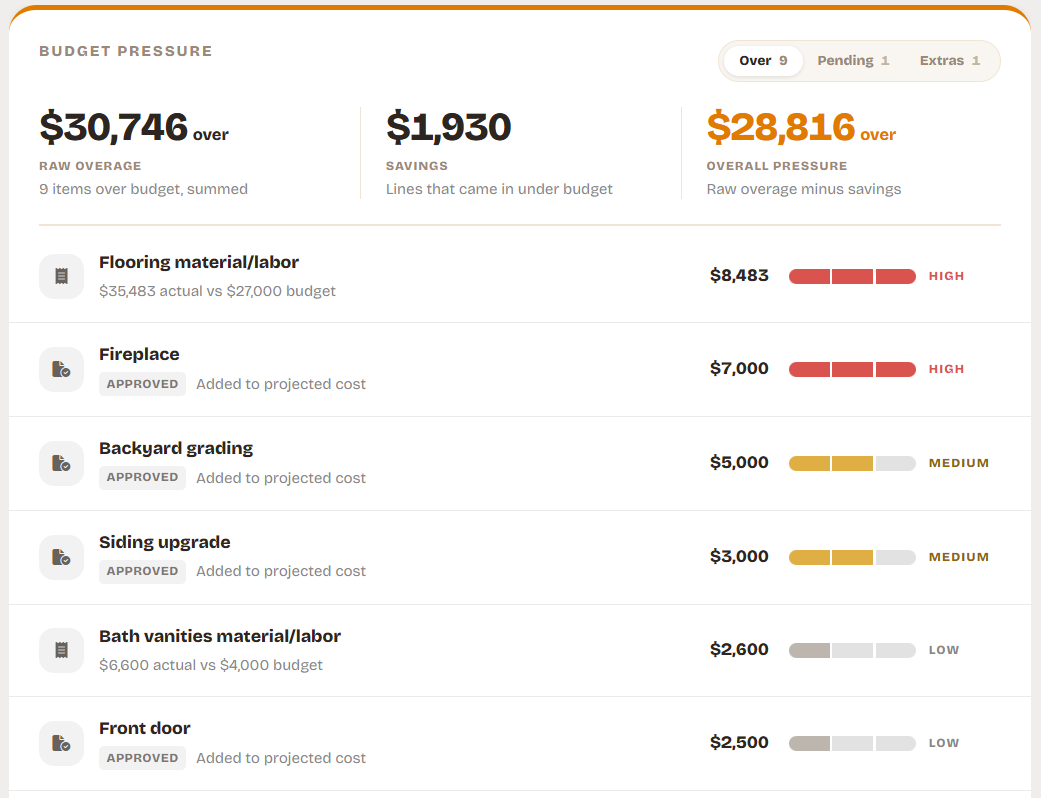
Treat contingency as a running balance, not a fixed number. Every time a cost comes in over budget, the contingency balance should decrease. Every approved change order that isn't covered by other funds should come out of contingency explicitly.
When you have used half your contingency but a lot of the build is still ahead, treat it as an early warning signal. Not a crisis, but a prompt to look closely at what's still ahead — what phases haven't been priced, what allowances are at risk, what subcontractor bids are still outstanding. At 0%, you're managing on pure reserves.
The earlier you have visibility into the contingency balance, the more options you have to respond. Scope reductions are easier and cheaper early in the build. Later, they're expensive, disruptive, or both.
Keep reading
Home Build Cost Calculator
Estimate the full cost of building a house, with land, fees, and contingency included, and check it against your loan and cash.
Open calculatorHow Change Orders Affect Your Budget
See how small scope changes quietly ripple through contingency, draws, and the finished-home payment.
Read guideHow to Budget a Custom Home Build
The four cost categories most homeowners miss, how to size contingency, and how change orders cascade through the budget.
Read guide