A construction loan is not a mortgage. It works differently, qualifies differently, and carries different risks — especially for owner-builders acting as their own general contractor. Here's what to expect from application through conversion.
12–18 mo
typical construction loan term
Interest-only
payments on what has been drawn during the build
43–45%
maximum DTI most construction lenders allow
How construction loans differ from traditional mortgages
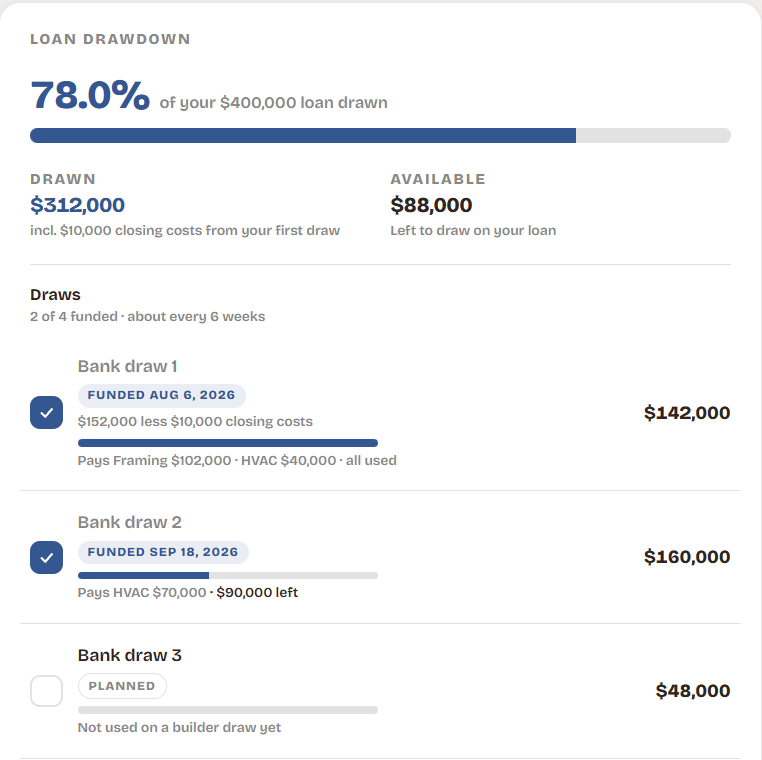
A traditional mortgage releases the full loan amount at closing to purchase an existing home. A construction loan works differently — it's a short-term credit facility that disburses funds in stages as construction progresses, with interest charged only on what has been drawn.
Construction loan terms are typically 12 to 18 months — long enough to complete the build. At the end of the construction period, the loan must convert to or be refinanced into permanent financing. Some lenders offer "one-time close" or construction-to-permanent loans that convert automatically, avoiding a second closing. Others keep the two loans separate, requiring a full refinance after the certificate of occupancy is issued.
Qualifying as an owner-builder
Most standard construction lenders require a licensed general contractor to oversee the build. Owner-builder loans — where you act as your own GC — are available, but the pool of willing lenders is smaller, documentation requirements are higher, and some lenders charge a higher rate or require a lower loan-to-value ratio to offset the added risk.
Lenders offering owner-builder financing typically require:
- A detailed construction budget with line-item breakdowns
- A draw schedule that matches realistic construction phases
- Evidence of construction experience, a dedicated project manager, or a professional construction consultant
- A larger down payment or more equity in the land
- Proof of reserves sufficient to cover cost overruns without additional lending
- A strong credit profile — typically 680 or above, though requirements vary
The stricter requirements reflect the lender's added risk. Without a licensed GC who carries insurance and a track record, there's more uncertainty about whether the build will be completed on time, within budget, and to a standard that supports the appraised value.
The draw inspection process
Before each draw is released, the lender sends an inspector or appraiser to verify that the work corresponding to that draw phase is actually complete. This protects the lender from funding work that hasn't happened — and it protects you from overpaying your builder before work is verified.
Builds that stay on schedule, with completed work ready for inspection at each milestone, move through draws smoothly. Builds with disputes, incomplete work, outstanding liens from unpaid subcontractors, or documentation gaps get delayed — sometimes significantly. A single delayed draw can stall the next construction phase if your builder requires payment before proceeding.
Interest-only payments during construction
During the construction period, you pay interest only on what has been drawn — not on the full approved loan amount. Early in the build, your monthly interest payment is low. As each draw is released, it increases. By the final draw, you're paying interest on the full loan balance. The construction loan interest calculator shows what that looks like for your loan.
This matters for budgeting your housing costs during construction. If you're also carrying a mortgage on your current home, you have two housing payments simultaneously: your existing mortgage plus the growing construction loan interest. At peak draw, that combined housing cost can be substantial — and it needs to stay within your debt-to-income limits.
Converting to a permanent loan
When construction is complete and the certificate of occupancy is issued, the construction loan must be paid off — either by converting to a built-in permanent loan or by refinancing with a new lender. At this point:
- The lender orders a final appraisal based on the completed home
- You close on the permanent mortgage, which begins full principal and interest payments
- Your monthly payment shifts from interest-only to a standard amortizing mortgage
With a two-close loan, the permanent rate is set by the market when you refinance at the end of the build, not when you took out the construction loan. One-time-close loans usually lock the permanent rate up front, though some let it float or offer a one-time float-down. If your rate is not locked and rates rise during the build, your permanent payment will be higher than what you originally modeled. This is one reason it's important to track the finished-home payment throughout the build, not just at the planning stage.
What lenders pay attention to beyond credit
Beyond income, assets, and credit score, construction lenders focus specifically on:
- Budget completeness — does the construction budget account for all cost categories, including soft costs, site work, and contingency?
- Draw schedule credibility — does the draw schedule match realistic construction phases, or are early draws front-loaded in a way that creates risk?
- Comparable sales — will the finished home appraise at a value that supports the loan amount?
- Reserves — if costs run over, do you have the cash to cover without requiring additional lending?
A well-organized financial picture — one that clearly shows the budget, funding sources, draw schedule, and projected finished-home payment — makes the approval process smoother and gives the lender confidence that the build is being managed carefully.
Keep reading
How Construction Draws Work
What draws are, how lenders release funds, how interest accrues, and how to track the draw schedule through the build.
Read guideDTI and Construction Loans
What debt-to-income ratio means for a construction loan and why the finished-home DTI is the number that matters most.
Read guideConstruction Loan Interest Calculator
See how much interest you pay while you build, month by month, from your loan size, rate, and build length.
Open calculator