Most homeowners start with a build cost from their contractor and treat it as the budget. It isn't. The true project cost includes four distinct cost categories — and missing any of them means the funding plan is built around a number that's already too low.
20–30%
rule-of-thumb gap between the build cost and the full project cost
10–15%
recommended contingency on base construction cost
8–12%
rough share soft costs add, and the part most homeowners undercount
Why most build budgets fall short
The number most homeowners start with — the build cost from their contractor or a preliminary estimate — is not the full budget. It's the starting point. What it usually doesn't include: soft costs, site-specific work, a real contingency, or the full exposure from allowance items that come in over estimate.
As a rule of thumb, the gap between "build cost" and "total project cost" often runs 20–30%, and more on difficult sites. Homeowners who don't account for this build a funding plan around a number that is already too low — before a single permit is pulled.
The four cost categories
A complete custom home build budget has four distinct cost buckets. Missing any of them means the starting number is wrong.
- Base construction cost — the contract price with your general contractor or builder. This covers labor and materials for the core structure and finishes specified in the plan.
- Site costs — work specific to your land: excavation, grading, well and septic if applicable, utility hookups, driveway, and landscaping. These vary widely by lot and are often the first category to get underestimated on rural or sloped sites.
- Soft costs — expenses that don't touch the physical structure: architectural drawings, engineering reports, permits, land surveys, inspections, loan origination fees, and title work. Typically 8–12% of base construction cost.
- Contingency — a reserve for cost increases within the original scope. The standard is 10–15% of base construction cost. This is not padding; it's a specific buffer for the unexpected.
Allowances deserve separate attention. An allowance is a budget placeholder for finish items — flooring, cabinetry, light fixtures — where the exact cost isn't fixed at contract signing. If allowances are set low and you spend more, the difference has to come from somewhere.
How to size contingency
Contingency isn't padding — it's a specific reserve for cost increases that fall within the original scope but couldn't be predicted precisely: material price changes, labor availability issues, unexpected site conditions, code requirements added after construction begins.
10% is the floor that most experienced builders and lenders recommend. 15% is more appropriate for complex builds, rural or difficult sites, or builds where the site conditions are not fully known before breaking ground. Anything below 10% means a single meaningful surprise can compromise the entire funding plan.
Change orders and how they cascade
A change order is any addition, deletion, or modification to the original scope after the contract is signed. Common examples: upgrading materials, adding square footage, changing a structural element, or addressing something discovered during construction.
Each change order affects the build in multiple directions simultaneously:
- The total projected cost goes up
- The draw schedule may shift — different phases need different amounts
- The contingency balance decreases if you're using it to absorb overages
- The final loan amount and potentially the permanent payment change
The cascade problem is that change orders don't arrive all at once. They accumulate throughout the build, and each one changes the picture a little. Without a system tracking the cumulative effect, you can be well into construction before realizing the budget has been quietly eroded — one reasonable decision at a time.
Keeping budget and funding connected
A budget that isn't connected to the funding plan is a static document. Every time something changes — a change order is approved, a draw comes in over estimate, a material substitution gets made — the budget updates but the funding picture doesn't, unless you do it manually.
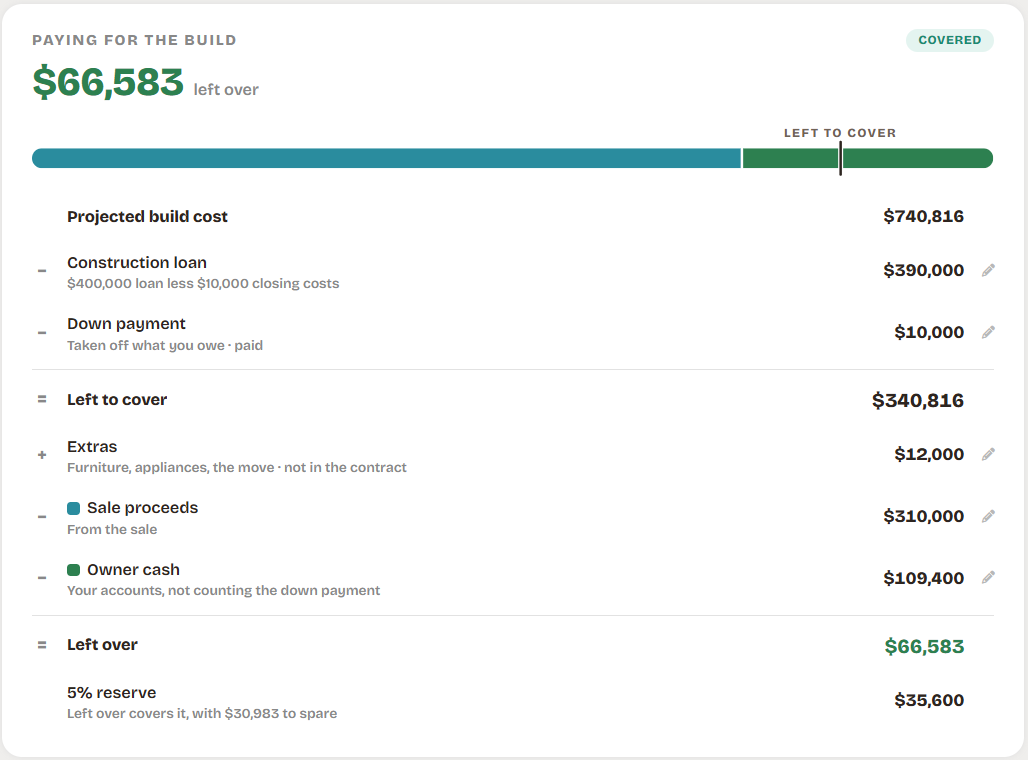
The question that matters at every point in the build: does your remaining funding still cover your projected remaining cost? If the gap is closing, you want to know before it closes entirely — not after the lender calls.
That means the budget needs to be live, not static. It needs to reflect real spend, approved change orders, and remaining draws — and it needs to be connected to the funding sources that are covering those costs.
Keep reading
Home Build Cost Calculator
Estimate the full cost of building a house, with land, fees, and contingency included, and check it against your loan and cash.
Open calculatorHow Much Contingency to Budget
Why 10–15% is the standard, what contingency actually covers, and what happens when it runs out mid-build.
Read guideHow Allowances and Selections Work
What an allowance covers, how your finish selections draw against it, and who pays when a pick goes over.
Read guide